
Livingston Court Records After Arrest
Livingston County sheriff releases show the local path in practical terms. After arrest, a person can be taken to Central Booking, held for pre-arraignment detention, and brought before LC-CAP at Livingston County Jail. The examples reviewed involved a town justice, the District Attorney's Office for the People, and the Public Defender's Office for the defense. The court may release the person, set bail or bond, set nominal bail on one charge while another hold controls custody, or remand the person without bail when New York law permits that result.
The jail and the court keep different records. Booking records may identify the arrest date, arresting agency, intake charges, custody status, and location. Court records after a jail arrest track the formal case, including accusatory papers, court dates, charge changes, warrants, disposition, and sentence if the case reaches that stage. For custody and booking detail, use Livingston County jail inmate records. For booking photos, use Livingston County jail mugshots. The court-record path is the better route for the charges filed after an arrest.
The NY Courts WebCriminal portal is the main free online starting point for selected pending criminal cases and future appearance dates. The portal itself notes that case information can have updating delays. If a recent Livingston County arrest is not visible there, the next step is usually the court or clerk that holds the file, not a commercial background-check page.
Livingston Court Records Search Fields
WebCriminal is built around case lookup rather than jail custody lookup. It lets a user begin from a known case identifier, a defendant name, or a court calendar. That makes it useful after a Livingston County jail arrest when the goal is to find the pending court appearance or the formal charge list. It does not replace the jail roster, VINELink, the County Clerk, or the Office of Court Administration criminal-history search.
| Field / Search Option | Type | Required | Options / Format Notes |
|---|---|---|---|
| Case Identifier | Search tab | Optional path | Search by Case Number or Summons Number. |
| Defendant Name | Search tab | Optional path | Search by defendant first and last name or corporation name. |
| Court Calendar | Search tab | Optional path | Generate a calendar by Court Part or Judge in Supreme and County Court. |
| WebCriminal Mobile | Link | Optional | Mobile version linked from the portal. |
| Related eCourts tools | Links | Optional | WebCivil Local, WebCivil Supreme, WebFamily, and eTrack are listed from the same entry page. |
The WebCriminal welcome page shows the search paths used for New York criminal case lookup.
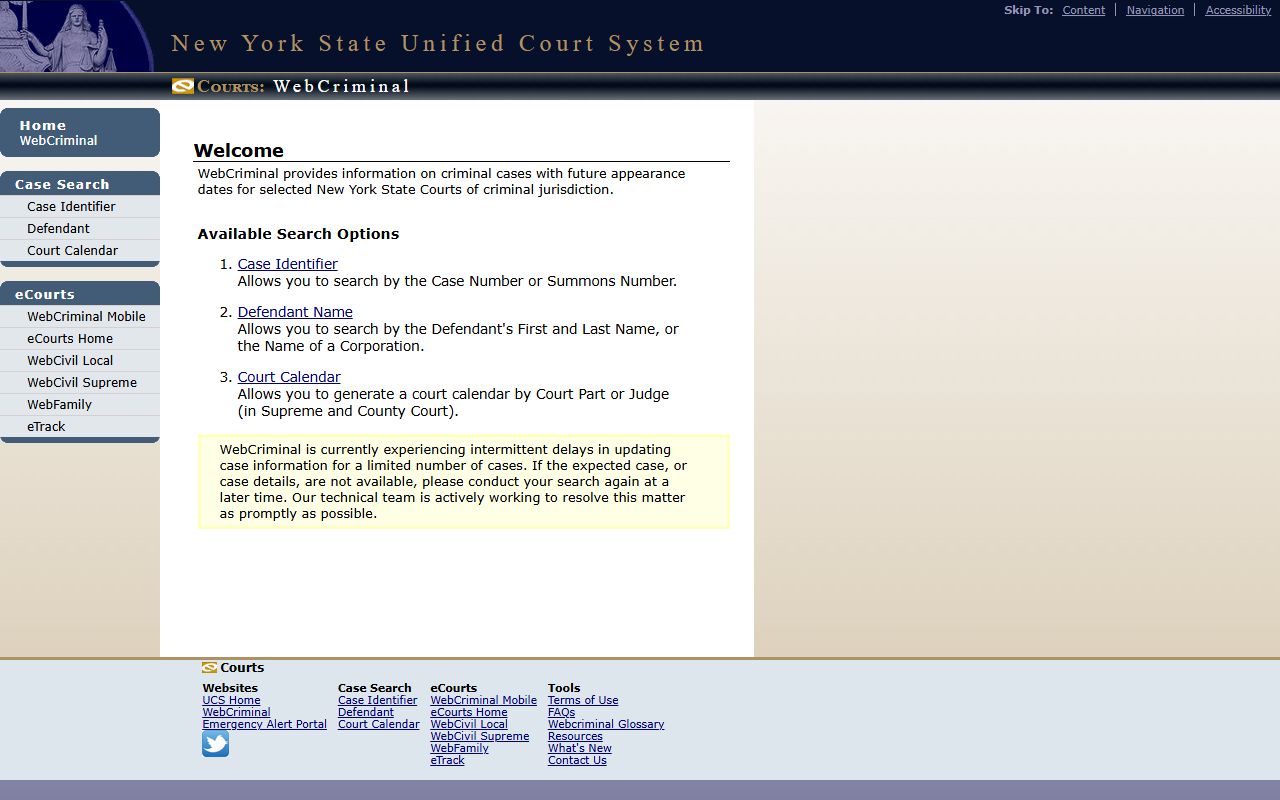
For a fresh arrest, search by defendant name first, then check any known case or summons number from release papers, bail paperwork, or a court notice.
- Start with the arrest paperwork, sheriff release, or bail receipt to identify the name, date, court, and charge wording.
- Search WebCriminal by defendant name for pending cases and future appearances.
- If the case is not shown, wait for updates or contact the court or Livingston County Clerk for the file route.
- Use CHRS only when a paid statewide criminal-history search is the right tool.
Note: WebCriminal is a court-case tool, so it may not show a person who is only being checked for current custody.
Livingston Arrest Charges Become Records
A charge shown at jail intake is an allegation at the booking stage. The court record starts to take shape through accusatory papers and later filings. In Livingston County, the District Attorney's Office represents the People and may appear at arraignment, recommend bail, present cases to a grand jury, try criminal cases, handle appeals, and advise town and village justices. Charge language can change as prosecutors review police reports, witnesses, lab results, warrants, or prior court history.
| Document | Who Uses It | What It Does | Common Livingston County Context |
|---|---|---|---|
| Complaint | Police or prosecutor | Starts or supports a criminal accusation. | Often tied to the first court appearance after booking. |
| Information | Prosecutor or court process | States the charge in a form used to move the case forward. | May be used in local criminal courts, depending on the case type. |
| Indictment | Grand jury | Charges a felony after grand-jury action. | Important in serious felony cases that proceed in County Court. |
The distinction matters because court records after an arrest can diverge from the booking entry. A sheriff release may state the arrest charge and the arraignment outcome, while the court file may later show a reduced charge, a superseding charge, a dismissal, or a conviction. A jail roster record is not proof that the person was convicted.
Livingston Court Charge Status
Charge status is the moving part of the case. A pending charge means the court has not reached a final outcome. An amended charge means the filed allegation changed. A reduced charge means the case moved to a lesser offense. A dismissed charge ended without a conviction on that charge. A disposition is the final court result, which may be a plea, verdict, dismissal, adjournment in contemplation of dismissal, or other case-specific outcome.
| Status | Plain Meaning | What To Check |
|---|---|---|
| Pending | The charge or case is still open. | Next court date, court part, bail or release terms, and any warrant history. |
| Amended | The charge language changed after filing. | Whether a new accusatory paper or court order explains the change. |
| Reduced | The charge moved to a lesser offense. | The original charge, current charge, and final disposition. |
| Dismissed | The charge ended without conviction. | Whether sealing applies and whether other charges remain open. |
| Disposed | The court entered a final outcome. | Plea, verdict, sentence, fine, conditional discharge, or dismissal terms. |
The Livingston County Clerk page says the office handles Supreme and County Court records and that criminal actions are index-only. It also states that actual files may be viewed only if the action is not sealed, not a youthful-offender case, and not a sexual-abuse matter.
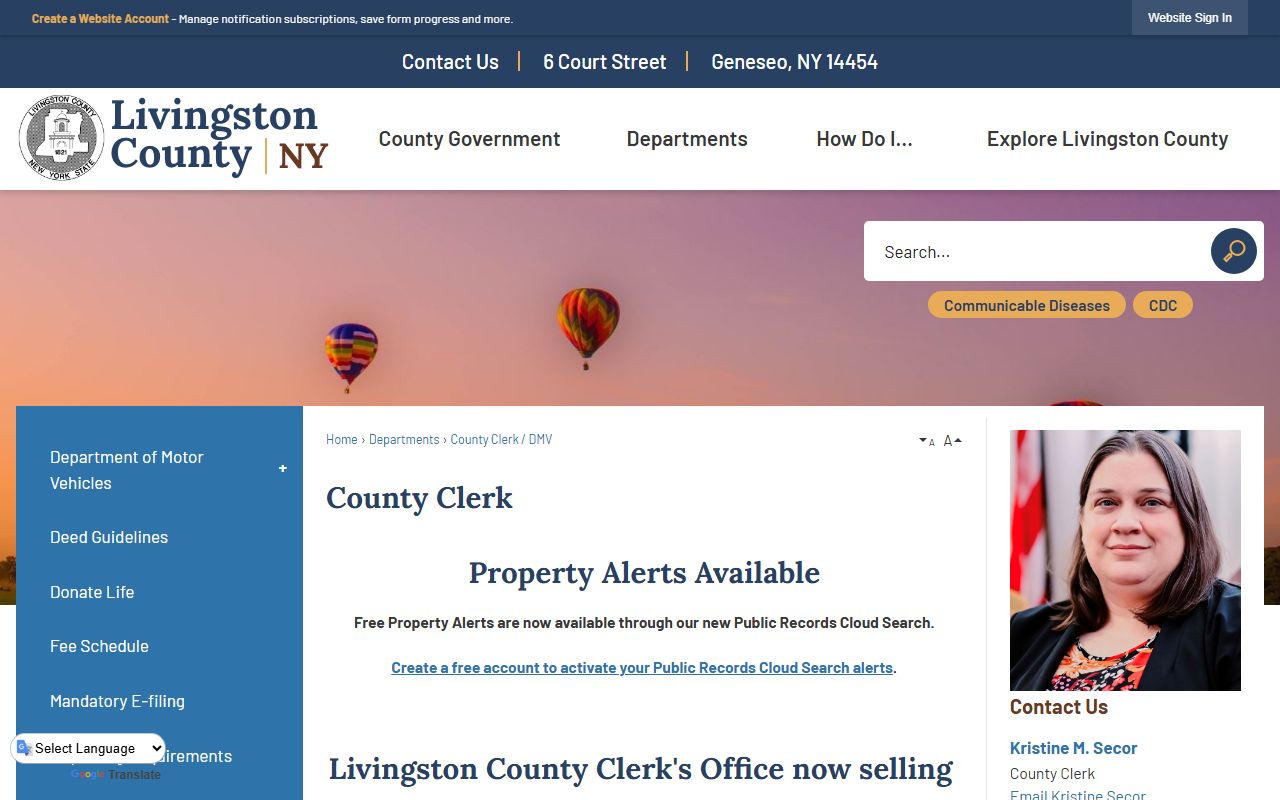
That local rule is important for Livingston County court records after an arrest because an index may exist even when the full file cannot be viewed by the public.
Livingston Bail and Remand Records
Bail and remand are court decisions, not jail decisions. Livingston County examples show the District Attorney's Office making bail recommendations and a town justice setting bail, bond, nominal bail, or remand. Release on recognizance means the person is released without money bail and must return to court. Non-monetary conditions can require supervision or check-ins where allowed. Cash bail and secured or partially secured bonds are money-based ways to secure court appearance. Remand means the court orders continued custody.
A no-bail hold or remand without bail can keep a person in jail even when family members expect a bond amount. Other holds can also block release. Federal, parole, state-ready, immigration, other-county, or warrant holds may keep a person in custody after a local bail issue is resolved. Call Livingston County Jail Division at 585-243-7180 before attempting payment because the official research did not locate a stand-alone county bail payment page with accepted methods and hours.
Important: Confirm the court order, payment office, exact amount, and any outside hold before trying to post Livingston County bail.
Livingston Warrants After Arrest
No official Livingston County public active-warrant roster was found in the inspected sources. That changes the search path. If the town, village, or court is known, call the issuing court first. If the person may already be in custody, call the Sheriff's Office main number at 585-243-7100 or the Jail Division at 585-243-7180. Staff may limit what can be discussed by phone, but the jail can confirm many custody questions better than a generic warrant site.
Sheriff releases show how a warrant can turn into a jail booking. A failure to appear can lead a town justice to issue warrants. Another agency may locate the person, transport the person to Livingston County, and then Central Booking Deputies process the person for pre-arraignment detention. After that, LC-CAP or the issuing court handles arraignment, bail, remand, or transfer. A bench warrant is usually tied to failure to appear. An arrest warrant authorizes custody on a criminal matter. A search warrant is different, since it authorizes a search rather than custody.
FOIL can be used for law-enforcement records through the Sheriff's Office, but active warrant or investigation material may be withheld when release would interfere with enforcement. The sheriff's tip line is for giving information, not for checking one's own warrant status.
Charges, Convictions, Sealed Records
A charge is an accusation. A conviction is a formal finding through a guilty plea or verdict. The burden for an arrest or charge is not the same as the proof needed for conviction. Court records after a jail arrest should be read with that distinction in mind, especially when a roster, news release, or pending docket is the only record found.
Charge
An allegation filed or carried in court. It can be pending, amended, reduced, dismissed, or disposed.
Conviction
A final guilty outcome by plea or verdict. It is separate from the fact that an arrest occurred.
New York also limits public access to some court and arrest records. Sealed records are hidden from ordinary public view under the applicable court order or statute, though some government access may remain. Expungement is often used by the public to mean a record is erased, but New York criminal-record relief more often works through sealing, youthful-offender treatment, dismissal-based sealing, or other restricted access. Livingston County Clerk access rules specifically exclude sealed, youthful-offender, and sexual-abuse-restricted files from public viewing.
Public or Index-Only
The clerk may be able to confirm index information while the full file is unavailable or limited.
Sealed or Restricted
The file is not open to ordinary public inspection because of sealing, youthful-offender, or case-type restrictions.
Livingston Statewide Record Search
CHRS is different from WebCriminal. The New York Courts Criminal History Record Search is a paid statewide Office of Court Administration search. The research file states that it costs $95 and uses exact name and date-of-birth matching. It can be useful when a broader New York criminal-history search is needed, but it is not a free docket search and should not be treated as a live jail roster.
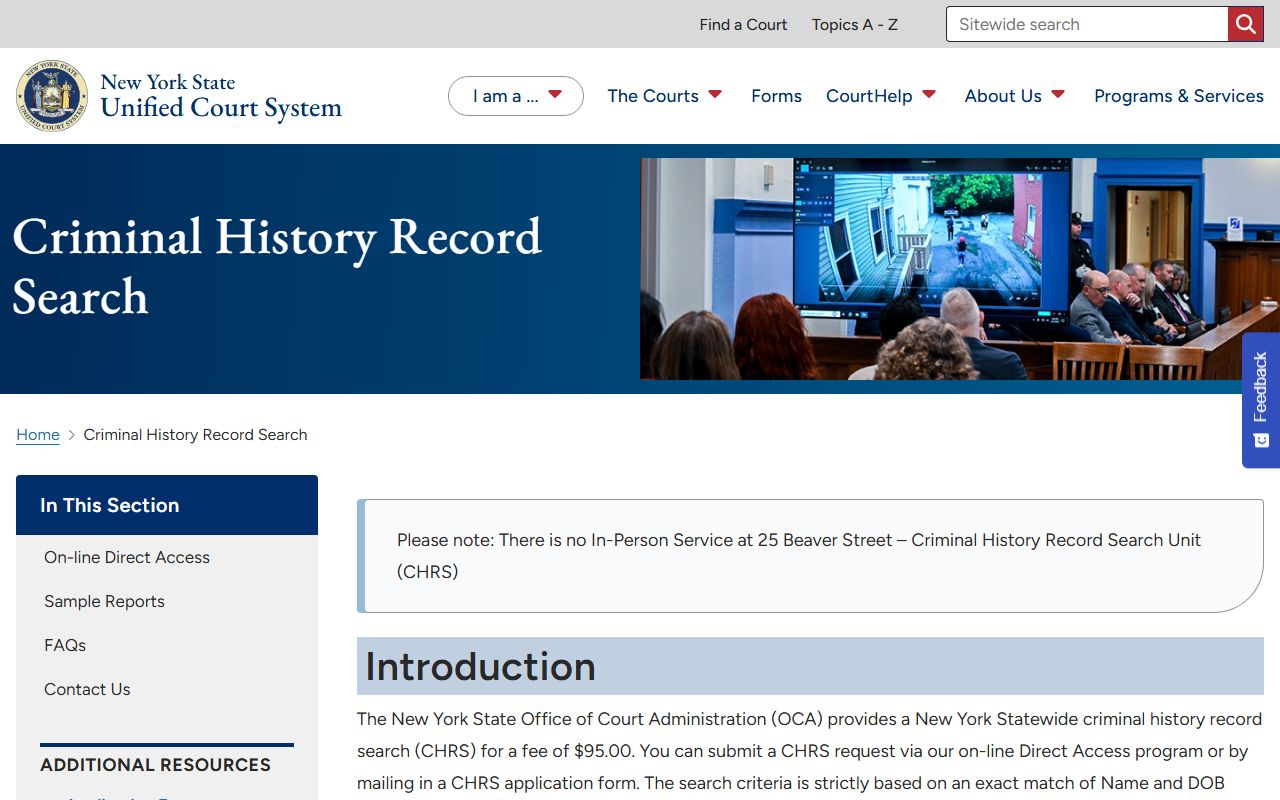
For a Livingston County arrest that just happened, WebCriminal, the local court, or the County Clerk will usually be more direct than CHRS. For a person's own official New York criminal-history record, the DCJS record-review process is a separate route.
Livingston DA Court Records Contact
The Livingston County District Attorney is Ashley Williams. The county DA page says the office prosecutes offenses recognized by county courts, advises and assists police when requested, prepares information requested by police, appears for preliminary hearings, presents cases to the grand jury, tries cases when a trial is demanded, handles appeals from criminal proceedings, and advises town and village justices. Sheriff releases show the DA's Office appearing for the People at LC-CAP and making bail recommendations.
The Livingston County District Attorney page lists the office contact block for prosecution questions and public-facing DA services.
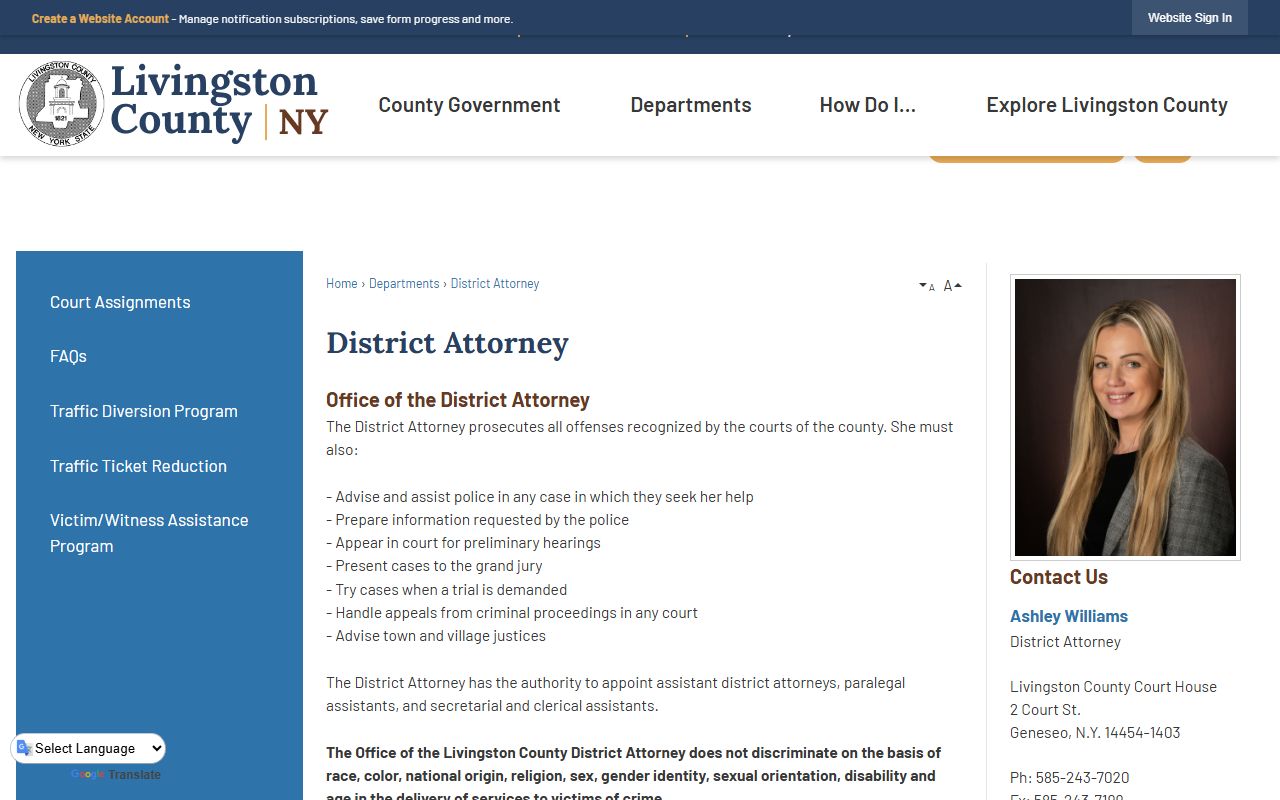
For copies of court files, contact the court clerk or County Clerk. For sheriff arrest reports, booking records, or law-enforcement records, use the Sheriff's Records Division and FOIL route. For prosecution questions tied to a pending case, the District Attorney's Office contact information is below.
Ashley Williams, Livingston County District AttorneyLivingston County Court House
2 Court St.
Geneseo, NY 14454-1403
Phone: 585-243-7020
Fax: 585-243-7199